

In New Jersey you are not buying outdoor furniture for summer. You are buying it for four seasons, roughly 20°F to 95°F, plus freeze-thaw cycles, humidity and whatever the winter does. That makes the frame material and the fabric the two decisions that matter, and the silhouette a distant third.
Get those two right and outdoor furnishings last a decade. Get them wrong and you replace cushions in year two.
Frames built for freeze and thaw
Teak is the benchmark. Its natural oil content means it can stay outside year-round, and left untreated it weathers to a soft silver-gray. If you want it to hold its honey color you will be cleaning and sealing it annually, which is a real commitment, not a formality.
Powder-coated aluminum is the practical alternative: it will not rust, it is light enough to move around, and the coating carries the finish. Check the welds and the coating quality, because that is where cheap aluminum fails.
All-weather wicker is not wicker. It is HDPE resin woven over an aluminum frame, and the thing to verify is that the resin is UV-stabilized — unstabilized resin goes brittle and cracks after a couple of New Jersey summers. Natural rattan, cane and untreated iron do not belong outdoors here at all.
Fabric is the whole game
Ask one question about any outdoor cushion: is it solution-dyed? In a solution-dyed acrylic the color is added to the fiber while it is still liquid, so the pigment runs through the strand rather than sitting on the surface. It does not fade in sun and it does not bleach when you clean it. Print-dyed fabric loses its color, and it loses it unevenly.
Two more things worth specifying. Quick-dry foam, so a cushion is usable an hour after a thunderstorm instead of the following afternoon. And drainage grommets, so water leaves the cushion rather than living inside it.
A roof buys you months
The single largest extension to an outdoor season is cover. A covered structure with fans for August and heaters for October turns a space that works ten weeks a year into one that works most of the year.
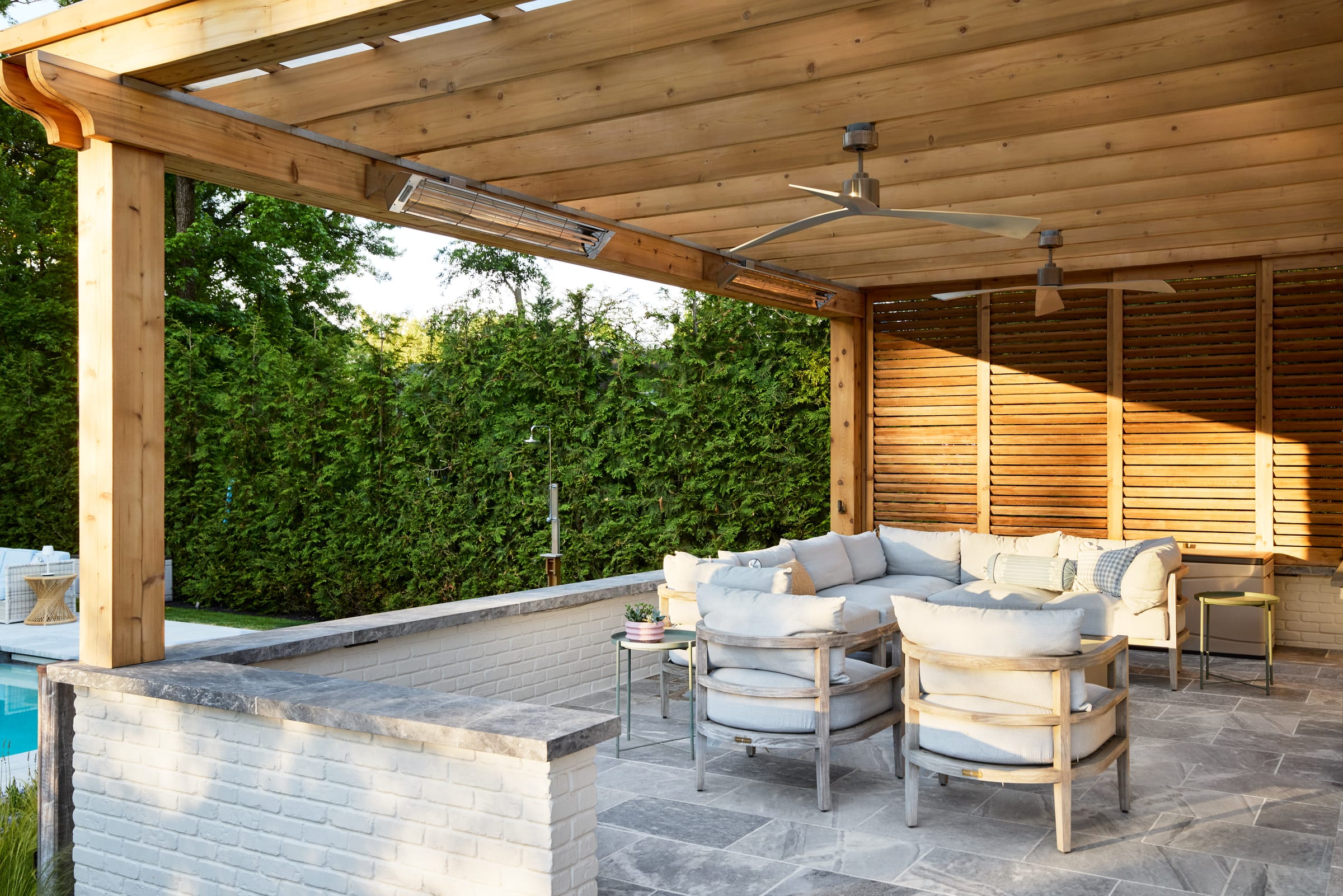
On a Westfield pool and outdoor living project, the covered cedar patio is an outdoor living room: cedar structure and privacy screening for warmth and definition, integrated fans and heaters to carry the space past the hottest weeks, and and deep lounge seating comfortable enough for an ordinary Tuesday. The backyard was planned around several ways of living outdoors — a covered lounge for shade and shelter, the pool deck for swimming and sun, dining and entertaining zones adjacent — rather than a single focal point.
Materials that connect the house to the yard
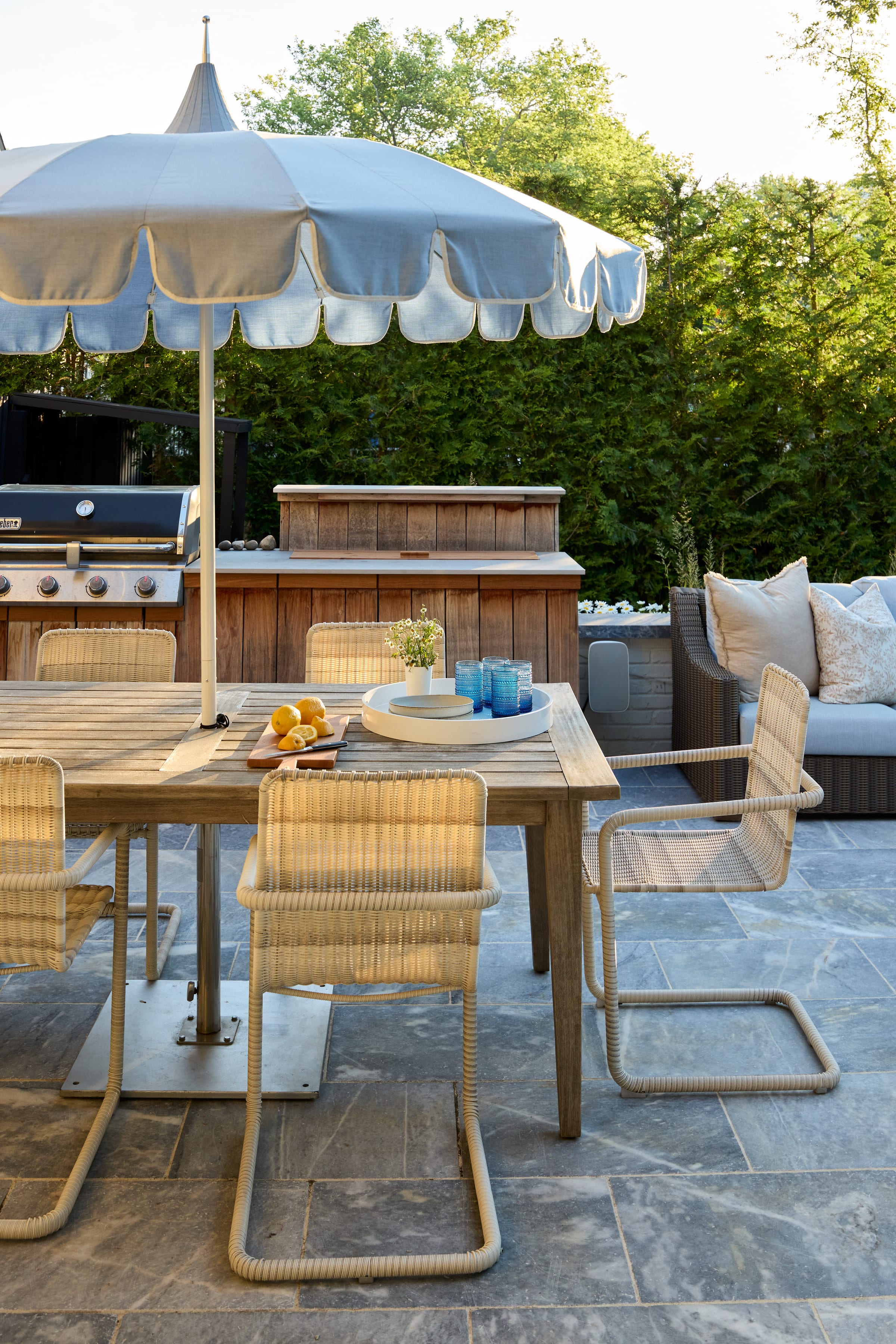
An outdoor space reads as part of the house when the materials repeat. Natural cedar, light stone, painted masonry, black-framed doors and metal roofing carried across zones give continuity from the back door to the far end of the property, so the architecture and landscape read as one environment instead of a series of features each making its own statement.
For outdoor counters, porcelain is the material that tolerates direct sun and freeze-thaw. Quartz is not rated for UV exposure and will discolor, which is a common and expensive mistake in outdoor kitchens.
Underfoot, choose hardscape for wet grip and for freeze-thaw stability. Pale stone paving also does something useful visually: it gives cedar, greenery and blue-and-white furnishings a quiet backdrop rather than competing with them.
The winter routine
Cushions come in. That is the one non-negotiable, and a deck box on the patio makes it likely to actually happen rather than a job that requires a trip to the basement. Teak and powder-coated aluminum can stay out; covers help but trap moisture if they are not breathable. Drain and shut down outdoor plumbing before the first hard freeze. Umbrellas come down — a scalloped umbrella is a sail, and a January storm will find that out.
The order to buy in
Cover first, if the budget allows it, because it multiplies the value of everything underneath. Then seating for the way you actually use the yard — deep lounge if you read outside, dining if you eat outside, both if the space genuinely supports both. Then shade. Then the layer that makes it feel finished: side tables, lighting, planting, textiles.
Outdoor projects involve structures, hardscape, utilities, lighting, landscape and furnishings all affecting each other, which is why we run them with construction consulting and furnishings coordinated rather than sequential. Start a project and tell us how you want to use the yard.