

Here is the short version. If you want the look of marble and never want to think about it again, choose quartz or porcelain. If you love marble and can accept that it will change, choose marble. If you want a natural stone that behaves like a workhorse, choose quartzite — and make sure it is genuinely quartzite. Everything below is the reasoning behind that.
Quartz: engineered, predictable, not heatproof
Quartz is an engineered surface — ground natural quartz bound with resin. Because it is non-porous, it never needs sealing, resists staining well, and behaves identically from one end of the slab to the other. For a busy kitchen it is the low-anxiety choice.
Two real limits. The resin is the weak point on heat, so a pan straight off the burner can scorch or discolor it; trivets are not optional. And it is not rated for direct sun, which rules it out for an outdoor kitchen.
Quartzite: the natural stone that works hard
Quartzite is natural stone, harder than granite and considerably harder than marble. It resists scratching and takes heat better than quartz. It is porous, so it needs sealing, and resealing on a schedule.
Buy it with your eyes open, because the naming in this category is genuinely unreliable. A meaningful share of slabs sold as quartzite are softer dolomitic marbles, which will etch like marble no matter what the label says. Ask your fabricator to test the slab, not the sample board.
Marble: beautiful, soft, and honest about it
Marble is calcite-based, which means acid attacks it. Lemon juice, wine, vinegar and tomato will etch the surface — a dulled mark, not a stain — and sealing does not prevent that. Sealing slows staining. Nothing stops etching.
This is not a reason to avoid marble. It is a reason to decide honestly whether you want a surface that records its use. Plenty of our clients do, and a marble kitchen that has been cooked in for five years is lovely in a way a new one is not. If you want the look with less evidence, specify honed rather than polished — a honed finish hides etching far better, because etching is itself a change in sheen.
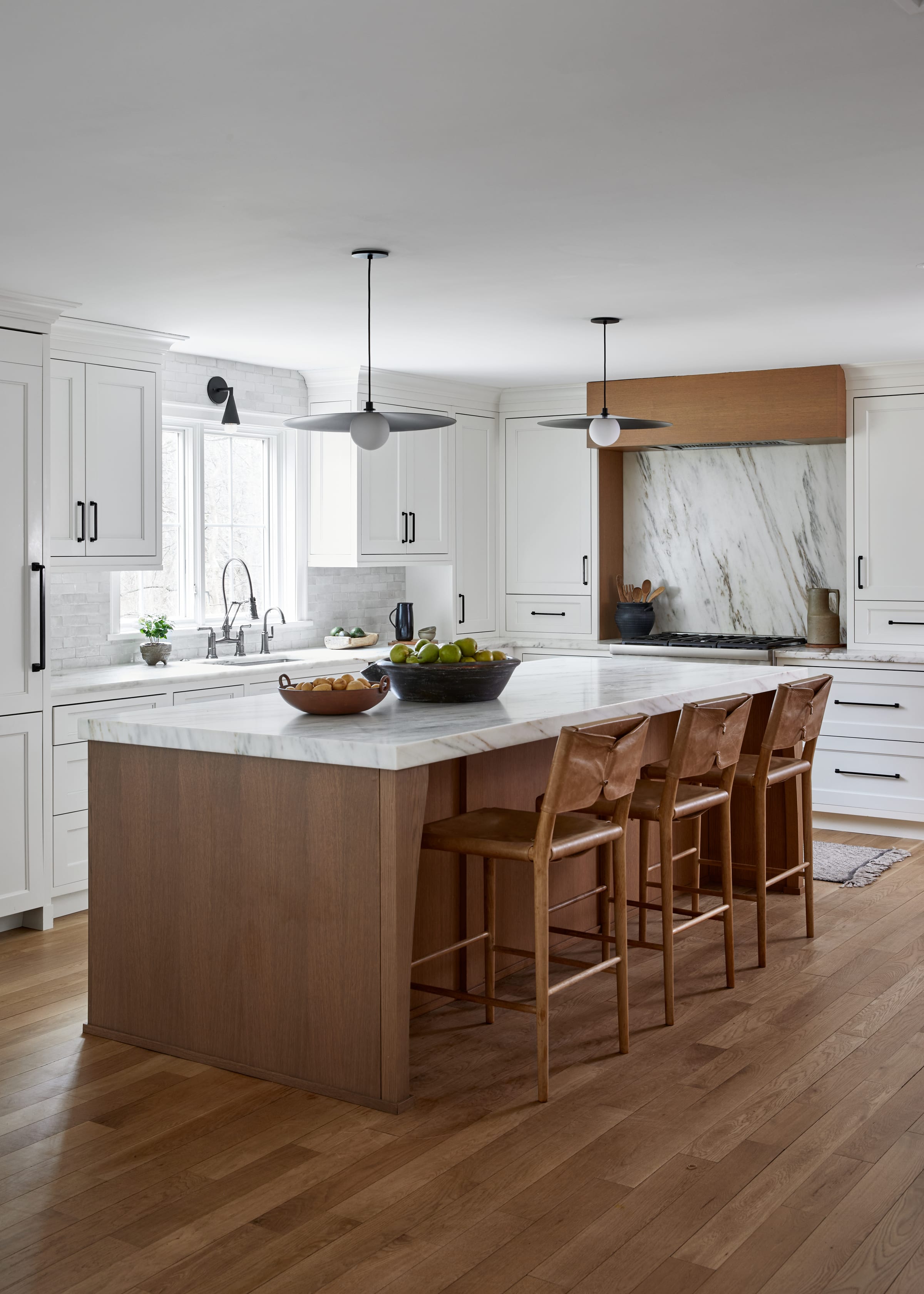
The marble kitchen in this Westfield renovation is a good example of the material used with intent, warmed by a curved dark oak island so the room does not read cold.
Porcelain: the one that goes outside
Porcelain slab is fired clay. It is non-porous, highly heat resistant, very scratch resistant, and UV stable — which makes it the sensible answer for an outdoor kitchen, where quartz cannot go and marble will not last.
Its weakness is edges. Porcelain can chip on a corner impact, and on many products the pattern is printed on the surface rather than running through the body, so a chip exposes a different color underneath. Through-body porcelain solves that and costs more. Fabrication also needs someone who works in porcelain regularly; it is less forgiving to cut than stone.
Different surfaces in the same kitchen
You do not have to pick one. A common and genuinely practical arrangement is marble or quartzite on the island where it is seen, with quartz on the working perimeter where the coffee, the cooking and the homework happen. Bakers sometimes want a marble section specifically, because it stays cool for pastry. A porcelain outdoor counter can echo the indoor stone without pretending to be it.
Bathrooms are more forgiving than kitchens. Marble in a primary bath sees almost none of the acid a kitchen sees, which is why a marble bath is a much lower-risk decision than a marble range wall.
How we help you choose
We start from how you actually cook, not from a mood board. Then we go and look at slabs in person, because natural stone is sold by the slab and photographs do not tell you what the veining does across a six-foot island. We look at the specific slab your counter will be cut from, decide honed or polished in front of it, and plan where the seams and the veining land.
Then we ask for a sample to live with. Put it next to your cabinet color, in your kitchen's actual light, for a week. Spill something on it. The material you are still happy with after that is your material.
If you would like that process run properly, with fabrication and installation coordinated alongside the rest of the work, that is what our full-service and construction consulting teams do together. Start a project and bring photographs of your current kitchen.